What 948 Linux Kernel Bugs Teach About Agent Verification Loops
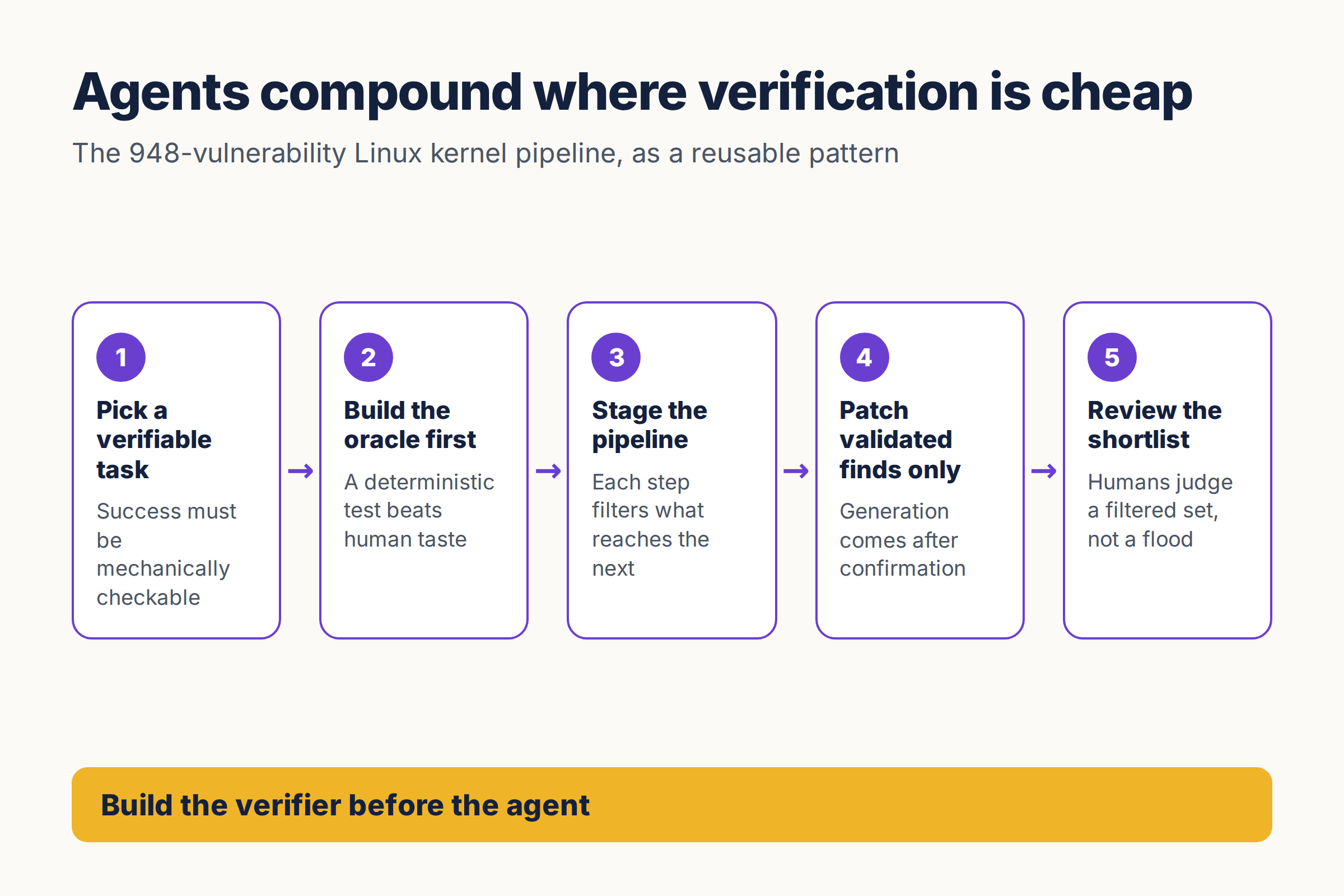
948 local privilege escalation vulnerabilities in the Linux kernel. Found, validated and patched by an autonomous pipeline. The number is impressive, but the reason it worked is the part worth copying.
The task has a mechanical oracle. An exploit either escalates privileges or it does not. No taste, no opinions, no vibe review. The pipeline can check its own work with code, not with judgment.
The work is staged. Discovery, validation and patch generation are separate steps, and each one filters what reaches the next. Patch code is only produced for findings that already passed validation.
That ordering is the actual design lesson. The expensive resource is human review, so the pipeline's job is to compress thousands of candidates into a shortlist a person can actually read.
Before you build an agent workflow, ask one question: what is the verification loop? If success can be checked by a script, an agent will compound gains. If every output needs a human to say yes or no, you have built an expensive suggestion box.
For fuzzy domains like writing or design, the same idea still applies, just weaker: build eval harnesses, sample multiple outputs, grade in bulk. Move the human to the end of the funnel, not into every step.
My honest take: the biggest engineering win of 2026 is not smarter models. It is teams getting disciplined about building verifiers.